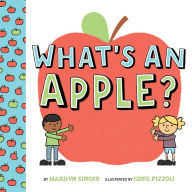
What's An Apple?

What's An Apple? Marilyn Singer. Illustrated by Greg Pizzoli. 2016. Abrams. 24 pages. [Source: Review copy]

First sentence: What's an Apple? You can pick it. You can kick it. You can throw away the core. You can toss it. You can sauce it. You can roll it on the floor. You can wash it, try to squash it, or pretend that it's a ball. You can drink it. You can sink it. Give your teacher one this fall!

Premise/plot: Marilyn Singer has crafted a poem answering the question, "What's An Apple?" The text is simple and rhythmic. Plenty of rhymes to be found. It reads pretty effortlessly.

My thoughts: I do like this one more than What's A Banana? Perhaps in part because I LOVE apples and don't really like bananas. But also because I think some of the rhymes are just better in this one. I really like the 'You can smell it, caramel it' line. The books do complement one another.

Text: 4 out of 5
Illustrations: 3 out of 5
Total: 7 out of 10

© 2016 Becky Laney of Becky's Book Reviews

What's A Banana?

What's A Banana? Marilyn Singer. Illustrated by Greg Pizzoli. 2016. Abrams. 24 pages. [Source: Review copy]

First sentence: What's a banana? You can grip it and unzip it. Smash and mash it with a spoon. You can trace it. Outer-space it--make believe that it's the moon.

Premise/plot: The whole book is a poem answering the question 'What's a Banana?'

My thoughts: Marilyn Singer writes poetry for children. Usually her books are collections of her poems. Not one poem stretched to cover an entire book. I have really enjoyed her work in the past, so I wanted to really like this one. I didn't quite. It was okay for me. I don't want my three minutes back or anything. I just wasn't wowed.

Text: 3 out of 5
Illustrations: 3 out of 5
Total: 6 out of 10

© 2016 Becky Laney of Becky's Book Reviews

Board Book: Cityblock

Cityblock. Christopher Franceschelli. 2016. Harry N. Abrams. 96 pages. [Source: Review copy]

First sentence: Big city, on-the-go city! How will we get around?

Premise/plot: Cityblock is a board book that celebrates New York City. The first part focuses on how to get around. The second part focuses on what to do. The third part focuses on FOOD.

My thoughts: I loved this one. I loved the actual pages: the die-cut format of some of the pages, the way the pages unfold, the bulky size and shape of it. The text itself is great because of the rhythm and rhyme nature of it. The illustrations are bright and colorful. Dare I say it's a board book that goes beyond its 'toddler and preschooler' audience?!

Text: 5 out of 5
Illustrations: 3 out of 5
Total: 8 out of 10

© 2016 Becky Laney of Becky's Book Reviews

What is a Child?

What is a Child? Beatrice Alemagna. 2016. Tate. 36 pages. [Source: Review copy]

First sentence: A child is a small person. They are only small for a little while, then they grow up. They grow without even thinking about it. Slowly and silently, their body grows taller. A child is not a child forever. One day, they change.

Premise/plot: "What is a Child?" That is the question asked and answered by author, Beatrice Alemagna. Her answers are thoughtful, and, at times poetic. She definitely takes the question seriously.

My thoughts: I really found myself loving the text. Here's a phrase that caught me: "The children who decide not to grow up will never grow up. They keep a mystery inside them." And another, "Children want to be listened to with eyes wide open."

While I loved the text, I didn't love the illustrations.

Text: 5 out of 5
Illustrations: 2 out of 5
Total: 7 out of 10

© 2016 Becky Laney of Becky's Book Reviews

Alamo All Stars

Alamo All-Stars (Nathan Hale's Hazardous Tales #6) 2016. Abrams. 128 pages. [Source: Library]

First sentence: Three hundred families...land grand....Texas...almost home.

Premise/plot: Nathan Hale and his two pals (the hangman and the British Officer) are joined by Juan Seguin and his three executioners (firing squad, I believe?) to tell the story of the Alamo. It doesn't rush into the story of the Alamo though. Readers learn about Mexico declaring its independence from Spain, the setting up and deposing of several Mexican governments, the arrival, with permission, of American settlers (families) into Texas, the clashes and near-clashes of those settlers with the native tribes in Texas (all given names, I won't mention them all here) and with the Mexican government. Not all Mexican leaders welcomed the idea of settlers, some feared that the more settlers there were, the more likely they would rebel and claim Texas for their very own. Readers learn about Stephen F. Austin, Jim Bowie, Sam Houston, Davy Crockett, William Travis, etc. Some of the people we learn about center around the Alamo--lived, fought, and died at the Alamo--some not. The book explores why they were fighting, what they thought they were fighting for, and their strong personalities that certainly didn't always help in their decision making.

My thoughts: Though a Texan, Texas history has not been my strongest subject especially when I was in school! I found this book a lot more interesting than a textbook. It also helps knowing that I'll never be quizzed on the subject again. Quite the difference between reading for the story and reading to remember names, dates, and places.

There were a LOT of characters in this one. It was fun that our familiar gang was joined by four more. Juan Seguin and his executioners added something to the story. I liked how the hangman came to get along with them and wanted to have a sleepover.

© 2016 Becky Laney of Becky's Book Reviews

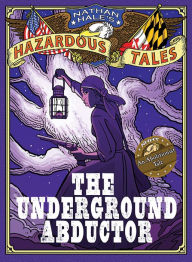
The Underground Abductor

The Underground Abductor. (Nathan Hale's Hazardous Tales #5) Nathan Hale. 2015. Abrams. 128 pages. [Source: Library]

First sentence: It is time to hang this spy! Are you sure? Can't we get one more story out of him first?

Premise/plot: Nathan Hale sets out to prove that America isn't perfectly perfect, and, that America has in fact "taken part in some truly horrible, despicable, abominable, atrocious, downright evil acts." He speaks, of course, of slavery. And in this graphic novel, he tells the story of Harriet Tubman (aka Araminta Ross). It's an intense story without a doubt. He speaks of her growing up in slavery, the abuses she faced, the challenges she overcame, her marrying a free man, her decision to run away, her decision to run back into slavery. For it became her mission to travel back and forth between North and South saving slaves--escorting slaves to safety, to Canada, in fact. All via the "underground railroad" of abolitionists. Some of this information I was familiar with, but, some was new to me. For example, I was not aware of her head injury perhaps leading to her narcolepsy. I had no idea of her visions either!

My thoughts: I am so glad I discovered this series. I really have enjoyed reading these books practically back to back. I would definitely recommend all of the books in the series. I hope it is a very LONG series.


© 2016 Becky Laney of Becky's Book Reviews

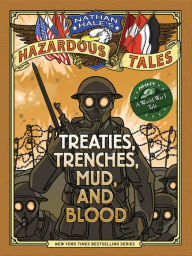
Treaties, Trenches, Mud, and Blood

Treaties, Trenches, Mud, and Blood. (Nathan Hale's Hazardous Tales #4) Nathan Hale. 2014. Abrams. 128 pages. [Source: Library]

First sentence: This prologue is brought to you by E Pluribus Hangman.

Premise/plot: Nathan Hale shares with the British soldier (Provost) and hangman a story of when England and America will no longer be fighting each other but best friends and allies. This graphic novel is about World War I. It selectively, yet descriptively, tells of the war, year by year. It is action-packed, and yet one knows it's not exhaustive in its coverage.

Each country mentioned (both those fighting and those holding onto their neutral status) gets an animal assigned to it. So most of the illustrations are of animals at war with one another. Serbia is a Wolf. The Austro-Hungarian Empire is a Griffin. Russia is a Bear. Germany is an Eagle. France is a Gallic Rooster. Belgium is a Lion. England is a Bulldog (since Lion was already taken). America is a Bunny (since Eagle is already taken). Australia is a Kangaroo. Canada is a Beaver. New Zealand is a Kiwi. India is a Tiger. Ottoman Empire is an Otter. Japan is a Raccoon Dog. Those are the countries I can remember.

World War I is a complex subject, there is a lot to digest. There are hundreds--if not thousands--of books written by adults for adults seeking to explain the war and exhaustively cover every battle, every victory, every loss. So it is an ambitious project to condense the war into a middle grade graphic novel.
Nathan Hale: War is built and controlled by human hands--humans start it, humans stop it.
Hangman: Then WHY DIDN'T THEY STOP IT EARLIER--BEFORE IT KILLED EVERYBODY?! WHY DID THEY LET IT OUT IN THE FIRST PLACE!? THEY SHOULD LOCK IT UP AND NEVER EVER LET IT OUT!!!
Provost: Calm down, Hangman! There are times when war is a necessity. Tell him it is so, Captain Hale.
Nathan Hale: I'm not here to judge which wars were necessary and which wars weren't. I just tell the story. World War I is best summed up by those who experienced it.
All war is a symptom of man's failure as a thinking animal. ~ John Steinbeck
My thoughts: I really thought this book was well done. Yes, it's a bit text heavy. Yes, there is a LOT of information packed into it, perhaps too much information to actually absorb and digest. But it's well-crafted and well-organized. I'm impressed by how Nathan Hale (the author) was able to break down all the information and present it in such a concise way. War is never glorified, yes, the Provost and Hangman sometimes get carried away with BATTLES, but, by the end, Nathan Hale (the spy) has moved them both with his story.

© 2016 Becky Laney of Becky's Book Reviews

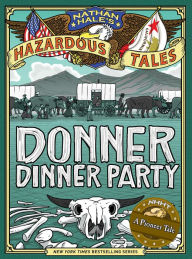
Donner Dinner Party

Donner Dinner Party. (Nathan Hale's Hazardous Tales #3). Nathan Hale. 2013. Harry N. Abrams. 128 pages. [Source: Library]

First sentence: Hear ye! Hear ye! Hear ye!

Premise/plot: Nathan Hale returns for this third hazardous tale in this graphic novel. The story that will prolong his life and delay his hanging is the story of the DONNER PARTY. His immediate audience, of course, is the hangman and a British officer. It's very convenient that since being eaten by the large American History book he can see the future and use the future to tell super-entertaining stories. Readers first meet the Reed family led by James Reed. Other families will be introduced as they journey west and join (and quit) wagon trains. The dangers are MANY. Some dangers are unpredictable and almost unavoidable. Other dangers they walk straight into confidently, sweeping away warnings. Usually if not always, always, it's the MEN making the decisions and the women and children who can do nothing but except the judgement of husbands and fathers. The story is FASCINATING AND HORRIBLE at the same time.

My thoughts: I really enjoyed this one. It is quite a compelling, absorbing read. You wouldn't think there would be a lot of characterization in a graphic novel, but, surprisingly there is. I had read very little if anything about the Donner Party, and, so I found it really interesting. I knew it was a grim story, but, I had not realized there were survivors too. So it wasn't quite as depressing as I first imagined it to be.

I definitely recommend this series of graphic novels. Even if you don't necessarily love reading graphic novels. The focus on history has me hooked. And I've become quite fond of Nathan Hale and his two would-be executioners.

© 2016 Becky Laney of Becky's Book Reviews

Popular Posts

Like us on Facebook

Flickr Images