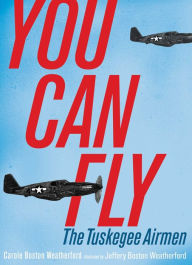
You Can Fly

You Can Fly. Carole Boston Weatherford. 2016. 96 pages. [Source: Library]

First sentence: No matter that there are only 130/ licensed black pilots in the whole nation. Your goal of being a pilot cannot be grounded/ by top brass claiming blacks are not fit to fly./ Your vision of planes cannot be/ blocked by clouds of doubt./ The engine of your ambition will not brake/ for walls of injustice--no matter how high.

Premise/plot: You Can Fly is a collection of poems--all written in second person, to you--about the Tuskegee Airmen. Readers can potentially learn a lot about flying and airplanes, the second world war, and race relations in the 1940s.

The perspective is unusual. But it oddly works for me.
You are in Class 42-C under all white command./ Your first lesson: to "Yes, sir!"/ and "Sir, no sir!" your officers.
The poems are still able to communicate a lot of details: names, places, dates, statistics, etc. Yet the poems are not dry and boring.
You love Hershey's bars,/ but letters from home are sweeter./ Hearing your name during mail call/ is like being lifted by a prayer.
My thoughts: I really enjoyed this one. I spent several years editing interviews for the Women Airforce Service Pilots. So while there are definite differences--big differences--between the two groups, it did give me an understanding or appreciation for training and flying at that time. My love of World War II is what led me to this one, not specifically the poetry. But the poetry is lovely I have to say!

It is a short, compelling read. It made me wish that MORE history subjects were covered through poetry. (Though not just any poetry would do, I suppose!)

I love the fact that it is just eighty pages. I do. In school, when I was on the younger side, when assigned to read a "nonfiction" book to give a report, I always looked for the SHORTEST book no matter the subject.


© 2016 Becky Laney of Becky's Book Reviews

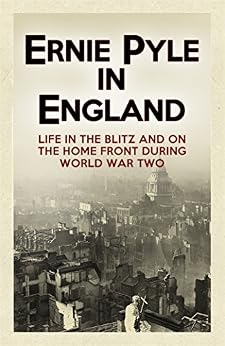
Ernie Pyle in England

Ernie Pyle in England. Ernie Pyle. 1941. 215 pages. [Source: Bought]

First sentence: A small voice came in the night and said, “Go.” And when I put it up to the boss he leaned back in his chair and said, “Go.” And when I sat alone with my so-called conscience and asked it what to do, it pointed and said, “Go.” So I’m on my way to London.

Premise/plot: Ernie Pyle in England was first published in 1941. It gathers together Ernie Pyle's newspaper columns from his time--three or so months--in England (and Ireland and Scotland). (He was an American journalist.) At the time the book was published, America had NOT yet entered the second world war.

My thoughts: WHY DID NO ONE TELL ME THIS BOOK EXISTED?! Seriously. I've gone all these years of my life not knowing about Ernie Pyle?!?!?! This one was a PERFECT fit for me. I love to read about England. (I do. I really do.) And I love to read about World War II. If you love history, this one may prove quite satisfying. And if you love human-interest stories, then this one will certainly satisfy!!!

I found it fascinating, entertaining, compelling, charming.

Quotes:
A ship carries people out of reality, into illusion. People who go away on ships are going away to better things.
Our bathtub has three faucets, one marked cold, and two marked hot. The point is that one is a little hotter than the other. I don’t know why it’s done this way. All I care about is that one or the other should give off hot water; and they really do — plenty hot. But our radiator does not have the same virtue. It is a centuries old custom not to have heat over here. All radiators are vaguely warm; none is ever hot. They have no effect at all on the room’s temperature. I’ve been cold all over the world. I’ve suffered agonies of cold in Alaska and Peru and Georgia and Maine. But I’ve never been colder than right here in this room. Actually, the temperature isn’t down to freezing. And it’s beautiful outside. Yet the chill eats into you and through you. You put on sweaters until you haven’t any more — and you get no warmer. The result is that Lait and I take turns in the bathtub, I’ll bet we’re the two most thoroughly washed caballeros in Portugal. We take at least four hot baths a day. And during the afternoon, when I’m trying to write, I have to let the hot water run over my hands about every fifteen minutes to limber them up. I’m telling the truth.
My new English friends wanted to know what America thought; and they told queer bomb stories by the dozen. “You’re a welcome sight,” they said. “We’ve all told our bomb stories to each other so many times that nobody listens any more. Now we’ve got a new audience.”
London is no more knocked out than the man who smashes a finger is dead. Daytime life in London today comes very close to being normal.
Some day when peace has returned to this odd world I want to come to London again and stand on a certain balcony on a moonlit night and look down upon the peaceful silver curve of the Thames with its dark bridges. And standing there, I want to tell somebody who has never seen it how London looked on a certain night in the holiday season of the year 1940. For on that night this old, old city was — even though I must bite my tongue in shame for saying it — the most beautiful sight I have ever seen. It was a night when London was ringed and stabbed with fire. They came just after dark, and somehow you could sense from the quick, bitter firing of the guns that there was to be no monkey business this night.
And Big Ben? Well, he’s still striking the hours. He hasn’t been touched, despite half a dozen German claims that he has been knocked down. Bombs have fallen around Trafalgar Square, yet Nelson still stands atop his great monument, and the immortal British lions, all four of them, still crouch at the base of the statue, untouched.
Londoners pray daily that a German bomb will do something about the Albert Memorial in Kensington Gardens. If you have ever seen it, you know why.
Apparently the national drink in England is a beef extract called Bovril, which is advertised everywhere, like Coca Cola at home. Yesterday I went into a snack bar for some lunch. I asked the waitress just what this Bovril stuff was, and in a cockney accent that would lay you in the aisle she said: “Why sir, it’s beef juice and it’s wonderful for you on cold days like this. It’s expensive, but it’s body-buildin’, sir, it’s very body-buildin’.” So I had a cup. It cost five cents, and you just ought to see my body being built.
If I were making this trip over again I would throw away my shirts and bring three pounds of sugar. 
You can hardly conceive of the determination of the people of England to win this war. They are ready for anything. They are ready to take further rationing cuts. They are ready to eat in groups at communal kitchens. Even the rich would quit their swanky dining rooms without much grumbling. If England loses this war it won’t be because people aren’t willing — and even ahead of the government in their eagerness — to assume a life of all-out sacrifice.
Don’t tell me the British don’t have a sense of humor. I never get tired of walking around reading the signs put up by stores that have had their windows blown out. My favorite one is at a bookstore, the front of which has been blasted clear out. The store is still doing business, and its sign says, “More Open than Usual.”
One of the few things I have found that are cheaper here than at home is a haircut. I paid only thirty cents the other day in the hotel barbershop, and since then I’ve seen haircuts advertised at fifteen cents. I’m going to get a haircut every day from now on — enough to last me for a year or two.
It was amazing and touching the way the Christmas spirit was kept up during the holidays. People banded together and got up Christmas trees, and chipped in to buy gifts all around. I visited more than thirty shelters during the holidays, and there was not a one that was not elaborately decorated.
I probably wouldn’t have slept a wink if it hadn’t been for the bathroom. I discovered it after midnight, when everybody else had gone to bed. The bathroom was about twenty feet square, and it had twin bathtubs! Yes, two big old-fashioned bathtubs sitting side by side with nothing between, just like twin beds. Twin bathtubs had never occurred to me before. But having actually seen them, my astonishment grew into approval. I said to myself, “Why not?” Think what you could do with twin bathtubs. You could give a party. You could invite the Lord Mayor in for tea and a tub. You could have a national slogan, “Two tubs in every bathroom.” The potentialities of twin bathtubs assumed gigantic proportions in my disturbed mind, and I finally fell asleep on the idea, all my fears forgotten.
It is hard for a Scotsman to go five minutes without giving something a funny twist, and it is usually a left-handed twist. All in all, I have found the Scots much more like Americans than the Englishmen are. I feel perfectly at home with them.
Pearl Hyde is head of the Coventry branch of the Women’s Voluntary Services. It was Pearl Hyde who fed and clothed and cheered and really saved the people of Coventry after the blitz. For more than a week she plowed around in the ashes of Coventry, wearing policeman’s pants. She never took off her clothes. She was so black they could hardly tell her from a Negro. Her Women’s Voluntary Services headquarters was bombed out, so she and her women moved across the street. Her own home was blown up, and even today she still sleeps in the police station. Pearl Hyde is a huge woman, tall and massive. Her black hair is cut in a boyish bob. And she has personality that sparkles with power and good nature. She is much better looking than in the film. And she is laughing all the time. She was just ready to dash off somewhere when I went in to see her, but she tarried a few minutes to tell me how good the Americans had been with donations.
It is against the law to leave a car that could be driven away by the Germans. You have to immobilize your car when you leave it, even though you might be walking only fifty feet away to ask a policeman for directions. In daytime, just locking the doors and taking the key counts as immobilization, but at night you have to take out some vital part, such as the distributor.

© 2016 Becky Laney of Becky's Book Reviews

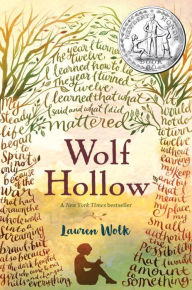
Wolf Hollow

Wolf Hollow. Lauren Wolk. 2016. 304 pages. [Source: Library]

First sentence: The year I turned twelve, I learned how to lie.

Premise/plot: Annabelle, the heroine, faces her hardest struggle yet in the year 1943 when a new girl at school, Betty, begins to bully her. Annabelle is reluctant to tell her parents--or her teacher--what is going on. Afraid that Betty won't stop bullying her and will start to bully her brothers as well. But one adult, a near-homeless war veteran named Toby, witnesses Betty in action. When one of Betty's pranks goes too far, Annabelle's world is turned upside down. Life will never be the same, could never be the same.

My thoughts: Wolf Hollow might suit other readers better than it suits me. The depiction of Annabelle's aunt, Lily, bothered me. "A tall, thin, ugly woman who might have been handsome as a man, Aunt Lily spent her days working as a postmistress and her nights praying and reading from her Bible...her big, square teeth and her feverish devotion to God frightened me." In every single scene with Lily, she's presented as a villain. And at least in Annabelle's eyes, part of the villainy, part of the "getting it wrong, being in the wrong" is connected with her aunt's Christian faith. If Lily was more than a one-dimensional character, if she was perhaps a complex creature with strengths and weaknesses, then perhaps I could forgive much. I don't mind characters with weaknesses. I really don't. In fact, give me a HUMAN character each and every time. But don't give me someone who is 100% wrong because she's 100% devoted to Christ and call it characterization.

That being said, Annabelle is a solid narrator. I really enjoyed getting to know her. She is a young girl in a difficult position forced to remain in a difficult position. There is plenty of drama and action and conflict in this one. I would say the drama almost overpowers the characterization, however. In particular, Betty and Andy were lacking in character development which is a pity. What motivates a person to act a certain way? What is going on in his or her life behind the scenes? I could think of half a dozen more WHY questions. And perhaps it's asking too much for an author to get inside the head of a bully or two. But I've read other novels--even for this audience--that go there better. I didn't "need" a redemption story where Annabelle and Betty become best friends over the course of a school year, and, all this misunderstanding is swept aside as both girls experience forgiveness and new beginnings. So I wasn't disappointed exactly with the turn of this story.

There are definitely things I like about Wolf Hollow--just not everything.

© 2016 Becky Laney of Becky's Book Reviews

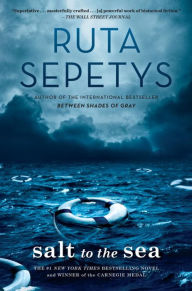
Salt to the Sea

Salt to the Sea. Ruta Sepetys. 2016. 391 pages. [Source: Library]

First Sentence: Guilt is a hunter.

Premise/plot: Salt to the Sea is a historical novel set during the last part of World War II alternately narrated by four teenagers: Joana, Emelia, Florian, and Alfred. Though the book may seem excessively mysterious and difficult to follow--at the beginning especially--I want to encourage readers to keep going, to keep reading. The BIG PICTURE story of this one is so worth it.

Joana's first sentence: Guilt is a hunter.
Florian's first sentence: Fate is a hunter.
Emilia's first sentence: Shame is a hunter.
Alfred's first sentence: Fear is a hunter.

So what might be nice to know: The end is fast coming. Danger is everywhere--depending on your nationality, your paperwork, your secrets. The 'liberation' coming from the Russian side is just as troubling and disturbing and good cause for fear as accidentally bumping into German Nazis. Three of our four narrators are slowly but surely making their ways to the Baltic Sea, to a port where they may luck into finding an escape aboard a ship. The fourth narrator is already there, a German already assigned to a ship. (That would be Alfred. He will actually be one of the people responsible for registering refugees to the ships and assigning who goes where, who gets on board and who is left behind.) All four seem destined to be aboard Wilhelm Gustloff.

My thoughts: If I had to pick just a handful of words to describe this one: compelling, mysterious, intense, bittersweet. It was a WONDERFUL read. One of those books that remind you WHY you like to read in the first place. I was swept into this story, and, though it took me days to make it through the first fifty or sixty pages, I soon found it impossible to put down. The key to this one, I think, is just going for it: reading it in big chunks. You'll probably still have a few questions here and there, but, just keep going. The more you read, the more will ultimately be revealed.


© 2016 Becky Laney of Becky's Book Reviews

Paper Wishes

Paper Wishes. Lois Sepahban. 2016. FSG. 192 pages. [Source: Library]

First sentence: Grandfather says that a man should walk barefoot on the bare earth every day.

Premise/plot: Paper Wishes is a middle grade historical novel set during World War II. Manami, our heroine, soon finds herself ripped away from the life she knows and loves--along with her family, her friends, her neighbors--because she's Japanese-American. Manami's family includes her grandfather, her father, her mother, an older brother (Ron) and an older sister (Keiko). Manami and her grandfather are especially, especially close to their dog Yujiin. So close that Manami tries to sneak the dog onto the bus or train that is taking them away. It does not work. And the dog is taken from her. This traumatic event leaves her without a voice. She does not speak for months--almost the entire book. But just because she isn't speaking doesn't mean she doesn't have a way of expressing herself and finding a voice. She DRAWS. She paints. And she gives some of her drawings to the wind as PAPER WISHES. What does she wish for most of all? HER dog, of course. So she sends along dozens of drawings of Yujiin hoping that somehow these wishes will come true...

My thoughts: I really found this to be an emotionally compelling read. I loved Manami and her family. In particular, I love her, Ron, and the grandfather. (I don't honestly feel I got to know-know her parents. Though I liked them well enough). I really liked getting to know her teacher as well.

Anyone who enjoys character-driven historical novels with a lot of heart will enjoy this one.

© 2016 Becky Laney of Becky's Book Reviews

The Journey That Saved Curious George

The Journey That Saved Curious George. Louise Borden. 2016. HMH. 96 pages. [Source: Review copy]

First sentence: For many years, I was intrigued by the story of Margret and H.A. Rey's flight from Paris on bicycles in June 1940.

Premise/plot: This children's nonfiction book is just right for elementary readers. It begins by providing background and context for young readers. Hans Augusto Reyersbach and Margarete Waldstein grew up in Germany. Both were Jewish. At some point in the 1920s, he moves to Rio de Janeiro. She follows a little while after. They meet again there, and fall in love. Paris is one of the stops on their honeymoon--they are Brazilian citizens now--and Paris is where they decide to remain. They work many happy years together in Paris. But their work--and their lives--are threatened when World War II goes from being something you read about in the papers--to something happening a few miles outside the city limits.

As Jews, they are at great risk if they remain in Paris and Paris is captured by the Nazis. But. For better or worse. They waited a little too long to leave the city...in an easy way. The last rush sees them desperate to find two bicycles. I believe the book says he had to build the bicycles himself from parts. But it isn't just a story about saving the authors' lives, it's a book celebrating the manuscript that would become Curious George. That was one of the possessions that they took with them--on their bikes. Of course what you may not know is that "George" wasn't George just yet. The monkey was originally called Fifi. And publishers had already agreed to publish the book before they made their flight...

The book focuses on H.A. and Margret Rey, their work as writers, and how the war effected their lives.

My thoughts: This is a very enjoyable read. I loved how the author was able to reconstruct their lives and give readers a behind-the-scenes look into the writing and illustrating of books. The book felt personal, but, always appropriate.

I would definitely recommend this one.

© 2016 Becky Laney of Becky's Book Reviews

Between Shades of Gray

Between Shades of Gray. Ruta Sepetys. 2011. Penguin. 352 pages. [Source: Library]

First sentence: They took me in my nightgown. Thinking back, the signs were there--family photos burned in the fireplace, Mother sewing her best silver and jewelry into the lining of her coat late at night, and Papa not returning from work. My younger brother, Jonas, was asking questions. I asked questions, too, but perhaps I refused to acknowledge the signs. Only later did I realize that Mother and Father intended we escape. We did not escape. We were taken. 

Premise/plot: I'm tempted to not give any premise or plot at all. To just say: READ THIS BOOK. But I'm not sure that's exactly fair. While, I do think this book should be read WIDELY, I think it's only fair to tell you a little bit about what to expect. It's set in 1941 in Lithuania. Lina, the heroine, and her family are in a difficult position. They're trapped between two worst-case-scenarios: Stalin, on one side, and Hitler on the other. No matter which "wins" control over Lithuania, Lina and her family--and so many others--are in great danger.

The book opens with Lina's family being arrested. It doesn't get any cheerier from that point. Lina, her mother, and her brother, Jonas, take the reader on quite an emotional journey. It's an incredible read, partly set in Siberia as well, which is where these 'prisoners' end up.

My thoughts: This was a reread for me. There is a companion book newly released this year starring Lina's cousin Joana. The companion book is set at much closer to the end of World War II. I read Salt to the Sea not really realizing its connection with Between Shades of Gray. It worked. So if you do read the books out of order, that is okay. But definitely I think you'll want to read both books.

I love this one. I do. I love the characterization. I really, really, really love Lina. And I love Andrius as well. Just because there is a tiny bit of romance, don't mistake this one for a proper ROMANCE. It's so much more than that. It's a fight for survival, and, a fight for DIGNITY. It is very bittersweet. But if you're looking for a book you can't put down, this one is it.


© 2016 Becky Laney of Becky's Book Reviews

Popular Posts

Like us on Facebook

Flickr Images