Savaged Lands

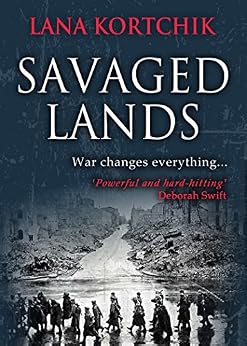
Savaged Lands. Lana Kortchik. 2016. 292 pages. [Source: Bought]

First sentence: It was a balmy September afternoon and the streets of Kiev were crowded. Just like always, cars screeched past the famous Besarabsky Market. And just like always, a stream of pedestrians engulfed the cobbled Kreshchatyk. Yet something was different. No one smiled, no one called out greetings or paused for a leisurely conversation in the shade of the many chestnut trees that lined the renowned street. On every grim face, in every mute mouth, in the way they moved – a touch faster than usual – there was anxiety, fear and unease. And only three teenagers seemed oblivious to the oddly hushed bustle around them.

Premise/plot: Natasha Smirnova's world is turned upside down by the Nazi's invasion of her hometown of Kiev in September 1941. Savaged Lands chronicles her life during the war.

My thoughts: I almost loved this one. I did. Why the almost? The love scenes were a bit too graphic for my personal taste. (I like things on the clean side). What did I love about it? The drama and intensity of it. The ugliness of war and the messiness of family life come together in this historical novel. I also thought the author did a good job creating complex characters. Not every single character perhaps. But the main characters certainly.

What did I like about it? The romance. The romance is both the novel's biggest strength and greatest weakness. It all depends on YOU the reader. If you love ROMANCE, if you love romance with DRAMA, with OBSTACLES, then you may love, love, love this one. It wouldn't be a stretch to say this one is more about a 19 year old girl falling madly, deeply in love for the first time than it is a novel about the second world war. If you love HISTORY more than romance, you might feel that too much emphasis is placed on her weak-in-the-knees, heart-pounding romance. Her life is practically unrecognizable, she's lost immediate family members, and all her thoughts are consumed in HIM. All the time it's him, him, him, HIM. (His name is Mark, I believe)

This one has plenty of tension and conflict. Is it good drama? or too melodramatic? I think again this is up to each reader. The conflict between Lisa and Natasha--two sisters--is very real and takes up a good portion of this one. Definitely gives readers something to think about as they keep turning pages.

© 2016 Becky Laney of Becky's Book Reviews

To Stay Alive

To Stay Alive. Skila Brown. 2016. Candlewick. 304 pages. [Source: Review copy]

First sentence: It is finished.

Premise/plot: I've got two sets of 'two words' that will either compel you to pick this one up or to avoid it. For better or worse. First: DONNER PARTY. Second: VERSE NOVEL.

Mary Ann Graves is the narrator of this historical verse novel. She was nineteen at the start of the journey in the spring of 1846. This one is divided into seasons: spring, summer, fall, winter. Almost all of the poems involve the traveling west and surviving aspect of the pioneer spirit. The landscape and environment do feature in quite a bit. Especially the SNOW.

What this book is not is Little House On the Prairie. This isn't even THE LONG WINTER. People do have tendencies to group books together. That is why I think it is important that DONNER PARTY leap out at you first before you hear of wagon trains, prairies, pioneers, homesteaders, or going west.

My thoughts: There is a bareness to the poems that oddly enough works for me. The narrator does not wear her heart on her sleeve. She's not overly dramatic and sensitive. She doesn't speak of her dreams and feelings and there is absolutely no gushing. (She's no Ann-with-an-e Shirley.)

When I say the poems avoid gushing, I don't mean they are void of description and detail.
The men think they're/ following a trail, a road/ well marked by wheels/ and feet, like a street,/ pointing you/ in the direction you need/ to go. But I know./ We follow a trail of broken things/ tossed from wagons--family heirlooms/ so heavy with memories/ the oxen couldn't pull--/ quilts, spinning wheels, dishes (too much/ dust to see the pattern), wooden bits,/ once part of something rich,/ portraits of great-grandmothers/ who'll spend eternity in the desert,/ watching beasts pull treasures/ while dirty people trail behind.
Some poems are long, descriptive. Others are very short and bare.
this land/ has eaten/ my feet/ chewed them/ ripped them/ cut them/ they bleed/ into land/ that drinks/ them up/ but it is never full
I am so glad I did not read anything about the Donner party as a child when I was obsessed with Laura Ingalls!!!


© 2016 Becky Laney of Becky's Book Reviews

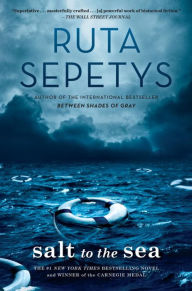
Salt to the Sea

Salt to the Sea. Ruta Sepetys. 2016. 391 pages. [Source: Library]

First Sentence: Guilt is a hunter.

Premise/plot: Salt to the Sea is a historical novel set during the last part of World War II alternately narrated by four teenagers: Joana, Emelia, Florian, and Alfred. Though the book may seem excessively mysterious and difficult to follow--at the beginning especially--I want to encourage readers to keep going, to keep reading. The BIG PICTURE story of this one is so worth it.

Joana's first sentence: Guilt is a hunter.
Florian's first sentence: Fate is a hunter.
Emilia's first sentence: Shame is a hunter.
Alfred's first sentence: Fear is a hunter.

So what might be nice to know: The end is fast coming. Danger is everywhere--depending on your nationality, your paperwork, your secrets. The 'liberation' coming from the Russian side is just as troubling and disturbing and good cause for fear as accidentally bumping into German Nazis. Three of our four narrators are slowly but surely making their ways to the Baltic Sea, to a port where they may luck into finding an escape aboard a ship. The fourth narrator is already there, a German already assigned to a ship. (That would be Alfred. He will actually be one of the people responsible for registering refugees to the ships and assigning who goes where, who gets on board and who is left behind.) All four seem destined to be aboard Wilhelm Gustloff.

My thoughts: If I had to pick just a handful of words to describe this one: compelling, mysterious, intense, bittersweet. It was a WONDERFUL read. One of those books that remind you WHY you like to read in the first place. I was swept into this story, and, though it took me days to make it through the first fifty or sixty pages, I soon found it impossible to put down. The key to this one, I think, is just going for it: reading it in big chunks. You'll probably still have a few questions here and there, but, just keep going. The more you read, the more will ultimately be revealed.


© 2016 Becky Laney of Becky's Book Reviews

Between Shades of Gray

Between Shades of Gray. Ruta Sepetys. 2011. Penguin. 352 pages. [Source: Library]

First sentence: They took me in my nightgown. Thinking back, the signs were there--family photos burned in the fireplace, Mother sewing her best silver and jewelry into the lining of her coat late at night, and Papa not returning from work. My younger brother, Jonas, was asking questions. I asked questions, too, but perhaps I refused to acknowledge the signs. Only later did I realize that Mother and Father intended we escape. We did not escape. We were taken. 

Premise/plot: I'm tempted to not give any premise or plot at all. To just say: READ THIS BOOK. But I'm not sure that's exactly fair. While, I do think this book should be read WIDELY, I think it's only fair to tell you a little bit about what to expect. It's set in 1941 in Lithuania. Lina, the heroine, and her family are in a difficult position. They're trapped between two worst-case-scenarios: Stalin, on one side, and Hitler on the other. No matter which "wins" control over Lithuania, Lina and her family--and so many others--are in great danger.

The book opens with Lina's family being arrested. It doesn't get any cheerier from that point. Lina, her mother, and her brother, Jonas, take the reader on quite an emotional journey. It's an incredible read, partly set in Siberia as well, which is where these 'prisoners' end up.

My thoughts: This was a reread for me. There is a companion book newly released this year starring Lina's cousin Joana. The companion book is set at much closer to the end of World War II. I read Salt to the Sea not really realizing its connection with Between Shades of Gray. It worked. So if you do read the books out of order, that is okay. But definitely I think you'll want to read both books.

I love this one. I do. I love the characterization. I really, really, really love Lina. And I love Andrius as well. Just because there is a tiny bit of romance, don't mistake this one for a proper ROMANCE. It's so much more than that. It's a fight for survival, and, a fight for DIGNITY. It is very bittersweet. But if you're looking for a book you can't put down, this one is it.


© 2016 Becky Laney of Becky's Book Reviews

Popular Posts

Like us on Facebook

Flickr Images