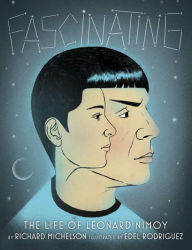
Fascinating: The Life of Leonard Nimoy

Fascinating: The Life of Leonard Nimoy. Richard Michelson. Illustrated by Edel Rodriguez. 2016. 40 pages. [Source: Review copy]

First sentence: Lenny took a deep breath and looked out at the playhouse stage.

Premise/plot: Richard Michelson has written a picture book biography of Leonard Nimoy. The book opens in 1939 with a young Lenny preparing to sing "God Bless America" at a talent show. He was the son of Russian immigrants--Jewish, and raised so. In fact, his inspiration for the Vulcan hand gesture--live long and prosper--came from a priestly blessing.

Readers learn about his interest in photography and acting. Both would be life-long pursuits and interests.

The book closes with Leonard Nimoy taking on the role of Spock and making it truly his own. The last illustrated spread depicts the first use of the "live long and prosper" from the episode Amok Time.

The next two pages fill out the rest of his life. He was an actor and a director. He was a photographer who displayed his photographs for the public, and, in fact published them as works of art. He was also an author.

The end brings a smile to my face. Before he left home, his mother encouraged him to learn to play the accordion. Acting jobs may come and go, she warned. But musicians can find a way to work. The book ends, "But he never did learn to play the accordion."

My thoughts: I LOVED this one so much. I thought it was very charming and well written. I did indeed find it fascinating. The author's note was great. I love that this book was written by one of Leonard Nimoy's close friends. I loved the personal touch--knowing that Nimoy read and approved of the project.

Text: 5 out of 5
Illustrations: 5 out of 5
Total: 10 out of 10

© 2016 Becky Laney of Becky's Book Reviews

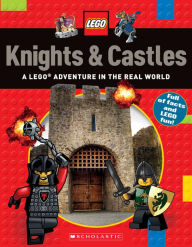
LEGO Knights & Castles

LEGO Knights & Castles. 2016. Scholastic. 64 pages. [Source: Review copy]

Knights and Castles is one of the first books in a Lego-themed nonfiction series published by Scholastic. The series is being marketed as "a Lego adventure in the real world."

What I liked about this one:

I enjoyed the nonfiction narrative. Both the main, flowing narrative that is simple and quick paced. And the overflow of facts found in the text of the side bars, asides, captions, etc. There is plenty of information packed into this one. And it's all appropriate for the elementary audience.

I enjoyed the layout. I liked the use of photographs, illustrations, and bright, bold colors. The book is designed to be appealing to readers. I think it works. It certainly looks nothing like the nonfiction from thirty or forty years ago.

I enjoyed two out of the three Lego features. I enjoyed the "Build it!" and Build it Bigger!" feature. I enjoyed the "Play it!" feature.
p. 15 Build it! Build a tournament area for your jousting knights!
p. 16-7 Play it! Find out about the stories of King Arthur's knights. What amazing adventures will your knights have? Do your knights argue, or are they friends? Is there a wizard in your knight world? Who is your most evil knight?
p. 29 Build it! Build a hospital for the Order of St. John to work in.
While I enjoyed the build it and play it features in Lego Planets, I really LOVED these two features in this one. I also found the narrative to be more compelling. (But that could be my love of history talking!!!)

What I didn't quite enjoy:

The illustrated Lego minifigures. I think there comes a point in your life where you grow up and grow beyond the kind of dialogue that these minifigures engage in. The speech bubbles are heavy on bad jokes and jests. It's just squirmy to read the text as as an adult. Kids, the intended audience, might have a complete different reaction.

© 2016 Becky Laney of Becky's Book Reviews

LEGO Planets

Lego Planets: A Lego Adventure in the Real World. 2016. Scholastic. 64 pages. [Source: Review copy]

Planets is one of the first books in a Lego-themed nonfiction series published by Scholastic. The series is being marketed as "a Lego adventure in the real world."

What I liked about this one:

I enjoyed the nonfiction narrative text. The main narrative text keeps things moving. Just a few sentences per page. Each two-page spread features more text: side bars, charts, captions for photographs, etc.

I enjoyed the layout. Big, bright, bold, colorful photographs.

I enjoyed two out of the three Lego features. Some spreads include a "build it" feature. Other spreads include a "play it" feature.
p. 37 Build it! Your astronauts need a space base. Design a space station. Here are some of the important partss. Solar panels. Living quarters. Docking station. Viewing window. Laboratory. Radiator.
p. 19 Play it! Take your astronauts to the Moon and help them explore. What will they find?
p. 26 Play it! Take your rover and astronauts to Mars! It's a whole new world of adventure. What will they find on the Red Planet? Will they be safe?
What I didn't really like:

I mentioned liking two out of the three lego features of this one. The third feature, the one that predominates the book, is the dialogue between Lego minifigures. These conversations are found in speech bubbles and are heavy on bad jokes. They add no intelligence to the book, in other words.

They are illustrated minifigures, by the way.


© 2016 Becky Laney of Becky's Book Reviews

The Hole Story of the Doughnut

The Hole Story of the Doughnut. Pat Miller. Illustrated by Vincent X. Kirsch. 2016. HMH. 40 pages. [Source: Review copy]

First sentence: Few remember the master mariner Hanson Crockett Gregory, though he was bold and brave and bright. But the pastry he invented more than 166 years ago is eaten daily by doughnut lovers everywhere. This is his story.

Premise/plot: Readers learn the true story behind the creation of the doughnut. Also how that story got embellished through the years into something more of a legend.

My thoughts: I liked it. I really did. I can't say that I loved, loved, LOVED it. But it was lively, engaging, entertaining, not particularly moralistic or educational. I don't remember picture book biographies being this entertaining when I was a child. So it's easy to recommend.

Text: 3.5 out of 5
Illustrations: 4.5 out of 5
Total: 8 out of 10

© 2016 Becky Laney of Becky's Book Reviews

The Wildest Race Ever

The Wildest Race Ever. Meghan McCarthy. 2016. Simon & Schuster. 48 pages. [Source: Library]

First sentence: The first Olympic marathon held in America happened on August 30, 1904, in Saint Louis, Missouri.

Premise/plot: This nonfiction picture book tells the wild-but-true story of the first Olympic marathon. McCarthy introduces us to ten runners out of the thirty-two that started the race. This story has plenty of twists and turns. It's never dull!

My thoughts: I really enjoyed this one. It appears to be well-researched. A select bibliography is included. And a link is provided for a full bibliography. It is well-written in my opinion! The story is lively and fun. I really liked the end papers!

It is probably best suited for slightly older readers. (Elementary perhaps instead of preschool.) It might make for a slightly awkward group read-aloud because there are a lot of sidebars and such in addition to the main narrative.

Text: 5 out of 5
Illustrations: 3 out of 5
Total: 8 out of 10

© 2016 Becky Laney of Becky's Book Reviews

What Are The Summer Olympics

What Are The Summer Olympics?  Gail Herman. Illustrated by Stephen Marchesi. 2016. 112 pages. [Source: Library]

I enjoyed reading Gail Herman's What Are the Summer Olympics? This short little nonfiction book for young(er) readers (think elementary school) covers all the basics. It provides a nice, little overview of the Olympics. Readers don't learn all there is to know about any one sport--or event--but readers learn a little bit about many of the most popular events. The chapters are actually arranged decade by decade. Each chapter typically covers two or three sports.

For example, the ninth chapter focuses on the 1980s. That chapter covers the U.S.A's boycott of the 1980 games, introduces readers to Mary Lou Retton (gymnastics), Carl Lewis (track), and Greg Louganis (diving).

Because over a hundred years worth of sports history is covered in this little volume, there isn't a lot of depth and substance. The book is a little over a hundred pages in length. BUT the book has a lot of illustrations.

Is it as FUN as Horrible Histories' Flame?!?! Sadly, no. But the book and song go VERY well together. The book, of course, covers A LOT more than any song parody could ever do it.

© 2016 Becky Laney of Becky's Book Reviews

Let Your Voice Be Heard

Let Your Voice Be Heard: The Life and Times of Pete Seeger. Anita Silvey. 2016. HMH. 112 pages. [Source: Review copy]

First sentence: Pete Seeger became the most important folk singer of the twentieth and twenty-first centuries. But he might have chosen a very different path. Although his grandfather made a fortune from sugar refining in Mexico, Pete became an advocate for underpaid workers. Though he came from financial privilege, he identified with those who had to make a living. He fought for the oppressed and poor all his life.

Premise/plot: Let Your Voice Be Heard is a biography of Pete Seeger written for children. (I'd say eight to twelve, if I had to put a label on it.) The biography is great at putting Pete Seeger's life into context for better understanding. Perhaps the author wanting to keep this one short and accessible for her audience, did not fully cover his life and music. It is not an exhaustive book on the subject. But a good, basic introduction.

My thoughts: I definitely found this one to be fascinating. I knew next to nothing about Pete Seeger before picking this one up. (I'm certainly no expert in folk music. My only familiarity at all coming from the music of Peter, Paul, and Mary.) I thought it was very well-written.

© 2016 Becky Laney of Becky's Book Reviews

The Journey That Saved Curious George

The Journey That Saved Curious George. Louise Borden. 2016. HMH. 96 pages. [Source: Review copy]

First sentence: For many years, I was intrigued by the story of Margret and H.A. Rey's flight from Paris on bicycles in June 1940.

Premise/plot: This children's nonfiction book is just right for elementary readers. It begins by providing background and context for young readers. Hans Augusto Reyersbach and Margarete Waldstein grew up in Germany. Both were Jewish. At some point in the 1920s, he moves to Rio de Janeiro. She follows a little while after. They meet again there, and fall in love. Paris is one of the stops on their honeymoon--they are Brazilian citizens now--and Paris is where they decide to remain. They work many happy years together in Paris. But their work--and their lives--are threatened when World War II goes from being something you read about in the papers--to something happening a few miles outside the city limits.

As Jews, they are at great risk if they remain in Paris and Paris is captured by the Nazis. But. For better or worse. They waited a little too long to leave the city...in an easy way. The last rush sees them desperate to find two bicycles. I believe the book says he had to build the bicycles himself from parts. But it isn't just a story about saving the authors' lives, it's a book celebrating the manuscript that would become Curious George. That was one of the possessions that they took with them--on their bikes. Of course what you may not know is that "George" wasn't George just yet. The monkey was originally called Fifi. And publishers had already agreed to publish the book before they made their flight...

The book focuses on H.A. and Margret Rey, their work as writers, and how the war effected their lives.

My thoughts: This is a very enjoyable read. I loved how the author was able to reconstruct their lives and give readers a behind-the-scenes look into the writing and illustrating of books. The book felt personal, but, always appropriate.

I would definitely recommend this one.

© 2016 Becky Laney of Becky's Book Reviews

Popular Posts

Like us on Facebook

Flickr Images