First sentence: When the Great War broke out, it came to me not as a superlative tragedy, but as an interruption of the most exasperating kind to my personal plans.
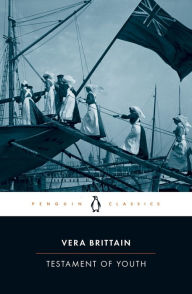
Premise/plot: In 1933, Vera Brittain published her autobiography, Testament of Youth, which covers the years 1900 to 1925. Much of the book focuses directly on the Great War (aka World War I) and its immediate aftermath. During the war, Vera Brittain left her university studies (Somerville College, Oxford) and became a nurse (V.A.D.). She worked as a nurse in England and abroad. (I believe she nursed in France and Malta.) Many of her friends actively served during the war. And those closest to her--including a brother and a fiance--were killed. She wrote honestly and openly about how brutal and devastating the war was, about how the war changed her and there was no going back after peace was declared.
When the book is not discussing the war, it often turns to education, politics, and social issues. Vera Brittain definitely was a feminist. She had VERY strong opinions on women's rights. But she didn't just speak out and speak up about women. She also was a voice for the poor and working class. She saw a lot of injustice and wanted to change the world.
Vera Brittain loved to be a lecturer or guest-lecturer. She had a LOT to say, and wanted to be HEARD wherever she went. This wasn't always the case. She was unhappy with certain groups--or clubs--that didn't value women's opinions and treat women as intellectual equals.
Also of interest perhaps, Brittain shares her experiences as a writer--her journey to publication and her thoughts on the literary world.
The very last chapter is a relief--after spending so many chapters distancing herself from humanity by focusing on POLITICS and WORLD AFFAIRS--focuses instead on her deep friendships and ultimate marriage. She struggled a lot with the idea of marriage. Can she marry and still be a feminist? Can she marry even though she has every intention of staying a career woman? Can she marry even though children are the very last thing (almost) on her mind? She spent so long speaking out against marriage and traditional roles for women, that she is almost ashamed and embarrassed that she fell in love.
My thoughts: It was REALLY long. Overall, I thought it was slightly uneven. It was at times quite fascinating and compelling, but, then at times it was also quite sluggish and boring. There would be pages that definitely kept me reading and kept me caring. I will say that the movie did a great job condensing the book and capturing the spirit of it. Not that the movie is 100% faithful to the book. (No movie is).
Quotes:
There is still, I think, not enough recognition by teachers of the fact that the desire to think--which is fundamentally a moral problem--must be induced before the power is developed. Most people, whether men or women, wish above all else to be comfortable, and thought is a pre-eminently uncomfortable process; it brings to the individual far more suffering than happiness in a semi-civilized world which still goes to war, still encourages the production of unwanted C3 children by exhausted mothers, and still compels married partners who hate one another to live together in the name of morality. (40)
I am inclined to believe that provincial dances are responsible for more misery than any other commonplace experience. (51)
Most of us have to be self-righteous before we can be righteous. (56)
How curious it seems that letters are so much less vulnerable than their writers! (124)
Even my work-driven uncle at the bank wrote a long letter, enclosing a fragment of philosophy which had recently come to England from the French trenches: "When you are a soldier you are one of two things, either at the front or behind the lines. If you are behind the lines you need not worry. If you are at the front you are one of two things. You are either in a danger zone or in a zone which is not dangerous. If you are in a zone which is not dangerous you need not worry. If you are in a danger zone, you are one of two things; either you are wounded or you are not. If you are not wounded you need not worry. If you are wounded you are one of two things, either seriously wounded or slightly wounded. If you are slightly wounded you need not worry. If you are seriously wounded one of two things is certain--either you get well or you die. If you get well you needn't worry. If you die you cannot worry, so there is no need to worry about anything at all." (306)
It seems to me that the War will make a big division of 'before' and 'after' in the history of the world. (317)
© 2016 Becky Laney of Becky's Book Reviews
- 12:35
- 0 Comments