I Am A Story

I Am A Story. Dan Yaccarino. 2016. HarperCollins. 40 pages. [Source: Library]

First sentence: I am a story. I was told around a campfire, then painted on cave walls. I was carved onto clay tablets and told in pictures. I was written on papyrus and printed with ink and woodblocks, then woven into tapestries and copied into big books to illuminate minds.

Premise/plot: The story's autobiography. The concept of 'story' is personified and communicated in very simple, basic terms that readers of all ages can appreciate.

My thoughts: LOVED it. Loved, loved, loved, LOVED it. It's so simple yet so brilliant. Would recommend to anyone and everyone who loves stories and storytelling. It's not just for people who love books and libraries, but, for anyone who celebrates storytelling and communities.

Text: 5 out of 5
Illustrations: 4 out of 5
Total; 9 out of 10

© 2016 Becky Laney of Becky's Book Reviews

Peppa Pig and the Little Train

Peppa Pig and the Little Train. 2016. Candlewick. 32 pages. [Source: Review copy]

First sentence: Peppa and George are visiting Granny and Grandpa Pig. Bang! Crash! Bang! Bang! "What's that noise?" asks Peppa. "Grandpa Pig is building a surprise for you," says Granny Pig.

Premise/plot: The book is an adaptation of a television episode of Peppa Pig. In this book, Peppa and George are surprised with Gertrude, a miniature locomotive made by their Grandpa. Soon, all their friends are riding Gertrude as well. One of the refrains of the book is that Gertrude is NOT a toy.

My thoughts: I LOVE this episode very much. But the book adaptation leaves a little to be desired. Not only has it been Americanized, but the lyrics to GRANDPA'S LITTTLE TRAIN SONG has been changed for no reason whatsoever. In the TV episode, Grandpa's little train goes CHOO, CHOO, CHOO. In the book, it goes CHUG, CHUG, CHUG. I don't expect the book to include the full song--it has multiple verses after all. But to not get the chorus right is just annoying. Any parent and child who KNOW the show, are going to KNOW the words to the "real song" and want to know WHY the book gets it wrong.

Text: 3 out of 5
Illustrations: 3 out of 5
Total: 6 out of 10

© 2016 Becky Laney of Becky's Book Reviews

Trains

Trains: A Pop-Up Railroad. Robert Crowther. 2016. Candlewick Press. 10 pages. [Source: Review copy]

First sentence: Locomotives. The first trains were just linked mining wagons pulled by human or horse power, used to carry coal and mineral ores back in sixteenth century Europe. The invention of the first powered locomotive in the early nineteenth century revolutionized the way a train moved.

Premise/plot: This is POP-UP book celebrating trains. It is an interactive book. Trains don't just pop-up on a few pages. There are flaps to lift and tabs to pull as well. Above all else, this one is packed with very detailed information.

Did You Know?
  • That Richard Trevithick built the first working steam locomotive in 1804.
  • That British trains began carrying passengers in 1829 and American trains began carrying passengers in 1830.
  • That Dr. Rudolf Diesel built the first diesel engine in 1897. 
  • That George Pullman introduced the first luxury sleeping cars in 1865.
  • That the fastest steam locomotive is/was the Mallard. It set the record in 1938 with 126 mph. The record has never been broken...by another steam train.
  • That the fastest train these days is the Japanese train, Maglev. It can go up to 374 mph!
My thoughts: I liked this one. I'm not a huge train enthusiast. But I know many people--of all ages--are. I think this one is a good and fun resource to have. It isn't so much a narrative to read aloud--there isn't a proper story. But it is a resource: plenty of definitions, explanations, illustrations, and such.


© 2016 Becky Laney of Becky's Book Reviews

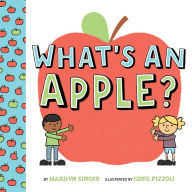
What's An Apple?

What's An Apple? Marilyn Singer. Illustrated by Greg Pizzoli. 2016. Abrams. 24 pages. [Source: Review copy]

First sentence: What's an Apple? You can pick it. You can kick it. You can throw away the core. You can toss it. You can sauce it. You can roll it on the floor. You can wash it, try to squash it, or pretend that it's a ball. You can drink it. You can sink it. Give your teacher one this fall!

Premise/plot: Marilyn Singer has crafted a poem answering the question, "What's An Apple?" The text is simple and rhythmic. Plenty of rhymes to be found. It reads pretty effortlessly.

My thoughts: I do like this one more than What's A Banana? Perhaps in part because I LOVE apples and don't really like bananas. But also because I think some of the rhymes are just better in this one. I really like the 'You can smell it, caramel it' line. The books do complement one another.

Text: 4 out of 5
Illustrations: 3 out of 5
Total: 7 out of 10

© 2016 Becky Laney of Becky's Book Reviews

What's A Banana?

What's A Banana? Marilyn Singer. Illustrated by Greg Pizzoli. 2016. Abrams. 24 pages. [Source: Review copy]

First sentence: What's a banana? You can grip it and unzip it. Smash and mash it with a spoon. You can trace it. Outer-space it--make believe that it's the moon.

Premise/plot: The whole book is a poem answering the question 'What's a Banana?'

My thoughts: Marilyn Singer writes poetry for children. Usually her books are collections of her poems. Not one poem stretched to cover an entire book. I have really enjoyed her work in the past, so I wanted to really like this one. I didn't quite. It was okay for me. I don't want my three minutes back or anything. I just wasn't wowed.

Text: 3 out of 5
Illustrations: 3 out of 5
Total: 6 out of 10

© 2016 Becky Laney of Becky's Book Reviews

Mustache Baby Meets His Match

Mustache Baby Meets His Match. Bridget Heos. 2015. 40 pages. [Source: Library]

First sentence: Baby Billy was born with a mustache.

Premise/plot: This is the sequel to Mustache Baby. In this second book, Baby Billy is mostly at odds with Baby Javier, a bearded baby. The problem? Baby Javier and Baby Billy both want to be THE BOSS and tell the other what to do. Also both babies want to be THE BEST. Can these two learn to be friends and get along?

My thoughts: I liked this one. I did. I don't know that I LOVED, LOVED, LOVED it like I did the first book. But I liked it. The illustrations make this a clever read. It's the little details--often in the illustrations--that bring a smile. For example, when the two compete at running for President.

Text: 4 out of 5
Illustrations: 5 out of 5
Total: 9 out of 10

© 2016 Becky Laney of Becky's Book Reviews

Amigo

Amigo. Byrd Baylor. Illustrated by Garth Williams. 1963. 48 pages. [Source: Bought]

First sentence: His mother said, "Come Francisco, my son. Tell me why your eyes are sad, my little one."

Premise/plot: Amigo is written in verse. It is historical fiction--about a boy longing for a dog. His family can't afford an actual dog, but, his parents encourage him to tame something wild, something that can take care of itself, something like a prairie dog. So Francisco sets out to tame a prairie dog, and, he knows just what he'll call it: Amigo. That's half the story. Amigo is a prairie dog that is curious and longs for adventures. He's drawn to humans, and he longs to tame a boy. Amigo picks out just the boy to tame, and, surprise, surprise, it's Francisco. Readers in on both sides of the stories can predict where this one is heading. It's cute.

My thoughts: I'll be honest: I bought it for the art. The illustrations are by Garth Williams. I thought if the text was nice, it would be an extra bonus. But really, I was just happy to see more of Garth Williams' work. I did enjoy the text. Do I think it's the most wonderful, amazing story ever? Probably not. I would have enjoyed more prose and less verse. But it's not awful.


© 2016 Becky Laney of Becky's Book Reviews

Popular Posts

Like us on Facebook

Flickr Images